
About this case: this is a composite case. It combines patterns that recur across data integrity remediation projects into one anonymised story. Company details, findings and timelines are representative, not a description of a single client.
Data integrity is no longer a niche finding. FDA issued 303 drug warning letters in 2025, 59% more than in 2024, and roughly one in seven referenced data integrity. This is how a mid-sized generics manufacturer went from an uncomfortable mock inspection to an inspection-ready laboratory in 120 days.
303
FDA drug warning letters in 2025
+59%
compared with 190 in 2024
~15%
of FY2025 letters cited data integrity
The starting point
The company makes oral solid generics for several MENA markets and was preparing for its first FDA pre-approval inspection. A mock inspection of the QC laboratory produced findings that every data integrity auditor will recognise:
Shared logins
Analysts on two HPLC workstations used one generic account.
No audit trail review
Audit trails were enabled but nobody reviewed them before batch release.
Orphan injections
Injections existed in the system that never appeared in reported results.
Admin rights everywhere
Laboratory supervisors could change system dates and delete data.
The 120-day plan
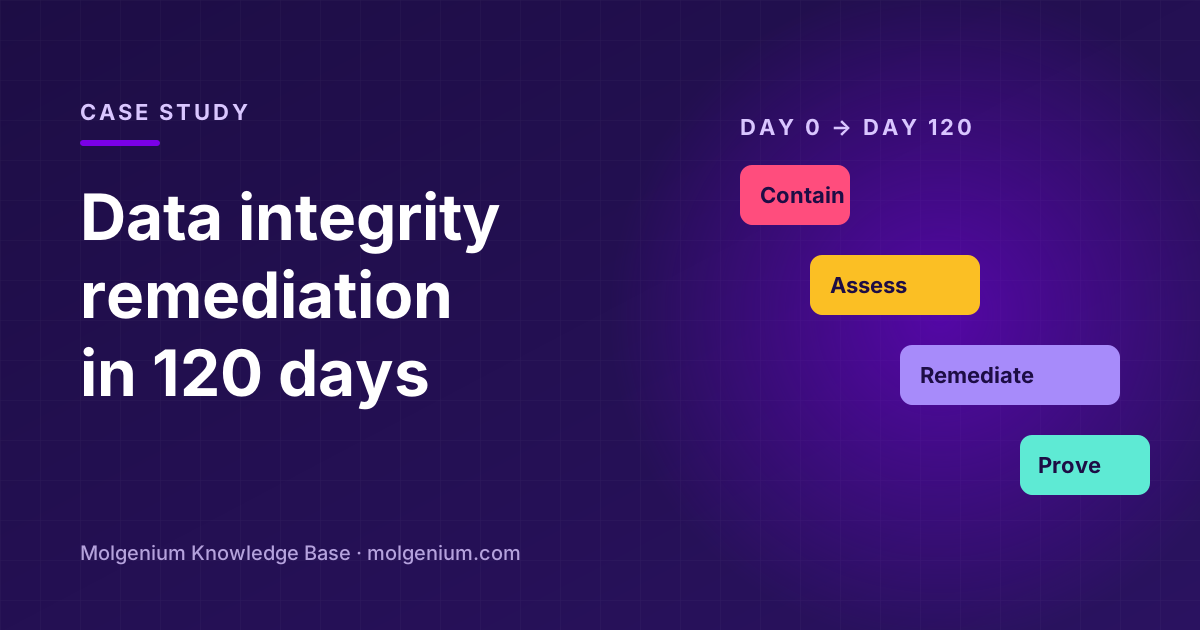
Days 0–14 · Contain. Shared accounts disabled, individual logins created, administrator rights moved from the lab to IT, system clocks locked. A retrospective review of audit trails for batches still on the market or awaiting release, with a documented product impact assessment.
Days 15–45 · Assess. Data-flow maps for every GMP computerised system in QC: where data is created, processed, reviewed, reported and archived. Each step rated for ALCOA+ risk. Root cause analysis showed the real problem was not individual behaviour but a quality system that never asked anyone to look at electronic data.
Days 30–90 · Remediate. Chromatography data system reconfigured with role-based access. A risk-based audit trail review procedure built into data review before release. A data integrity policy, revised good documentation practice training, and an escalation route for analysts who see something wrong.
Days 90–120 · Prove. Effectiveness checks on a sample of released batches, access reviews, and a second mock inspection by auditors who had not seen the first one.
Before and after
| Area | Before | After |
|---|---|---|
| User access | Shared accounts, broad admin rights | Individual accounts, role-based, reviewed quarterly |
| Audit trails | On, never reviewed | Risk-based review before every release |
| Knowledge | Data integrity seen as an IT topic | Data-flow maps owned by the lab, trained staff |
| Evidence | Policies on paper only | Effectiveness checks and a clean second mock inspection |
Five lessons that travel
Want to know where your site stands? Try our free GMP Mock Audit, which includes a data integrity area, or book a mock inspection with a Molgenium auditor.