
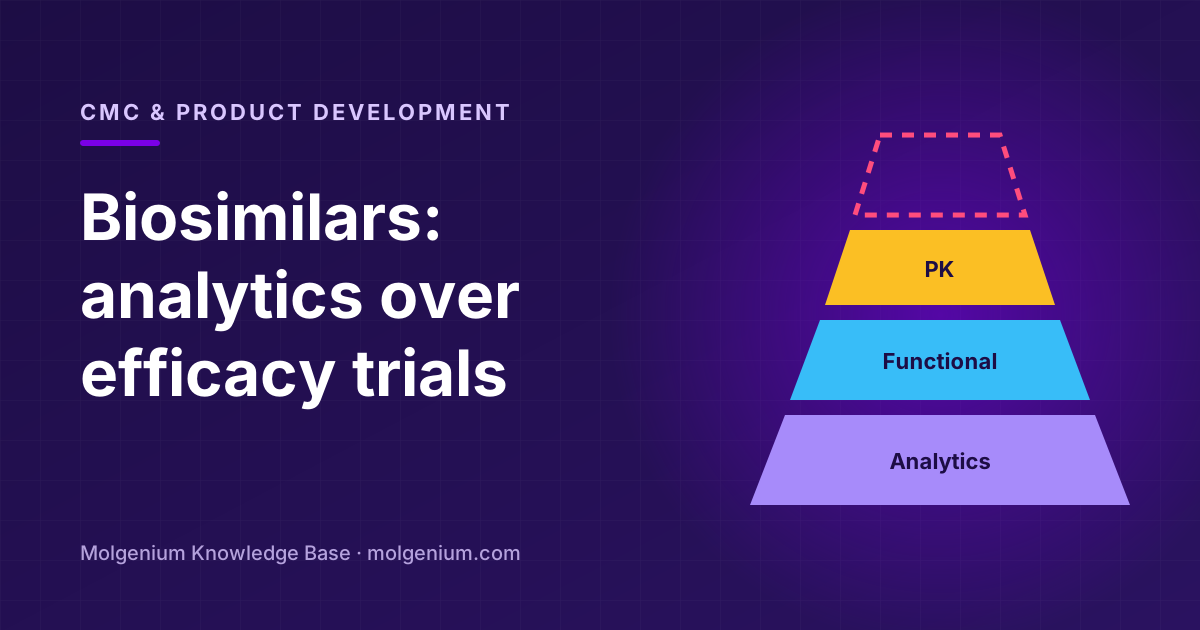
For twenty years, biosimilar developers have run large comparative efficacy studies to confirm what their analytics already showed. In 2025 and 2026, FDA and EMA both said that for most therapeutic proteins this is no longer necessary. The weight of the biosimilar dossier is moving from the clinic to the CMC laboratory.
What the regulators said
FDA. On 29 October 2025, FDA published draft guidance proposing that comparative efficacy studies (CES) are generally not needed to demonstrate biosimilarity when the products are made from clonal cell lines, are highly purified and can be well characterised analytically; when the relationship between quality attributes and clinical efficacy is understood; and when a comparative human pharmacokinetic study is feasible and clinically relevant. CES may still be required for products such as locally acting ones, where comparative PK is not feasible or relevant. At the time, only 76 biosimilars had been approved in the US. FDA also signalled that switching studies would no longer be expected for interchangeability.
EMA. EMA consulted on a reflection paper in 2025, and the CHMP adopted it on 16 March 2026. It concludes that a biosimilar may be approved without CES, and sometimes without pharmacodynamic data, if similar efficacy and safety can be inferred from a sufficiently stringent analytical comparison, in vitro pharmacology and a comparative clinical PK trial. A well-designed comparative PK study remains required.
Why this is a CMC story
Removing the efficacy trial does not lower the bar. It moves it. Regulators will accept less clinical data only if the analytical package is strong enough to carry the conclusion. That puts pressure on exactly the work CMC teams own.
The efficacy trial used to absorb analytical uncertainty. Without it, every gap in the comparability package is visible.
The opportunity for MENA developers
For regional biosimilar developers, the efficacy study was often the hardest part: expensive, slow and hard to recruit. A pathway built on analytics and a PK study favours companies that invest in strong laboratories and smart reference product strategies. Regional authorities that rely on FDA and EMA decisions are likely to follow, and Saudi Arabia is already streamlining registration for generics and biosimilars as part of its localisation push. The developers who win will be those who treat their analytical lab as a regulatory asset, not a cost centre.
Molgenium supports biosimilar and biologics developers with CMC strategy, analytical comparability planning and regulatory submissions. Talk to our CMC experts.
Sources
- RAPS: FDA proposes to cut comparative efficacy study requirements (October 2025)
- Jones Day: FDA's biosimilar playbook
- EMA: Reflection paper on a tailored clinical approach in biosimilar development (adopted 16 March 2026)
- The Medicine Maker: quality over quantity, EMA's new approach to biosimilars
- Freyr: Saudi Arabia 2026 and the SFDA's push for generics, APIs and local manufacturing