
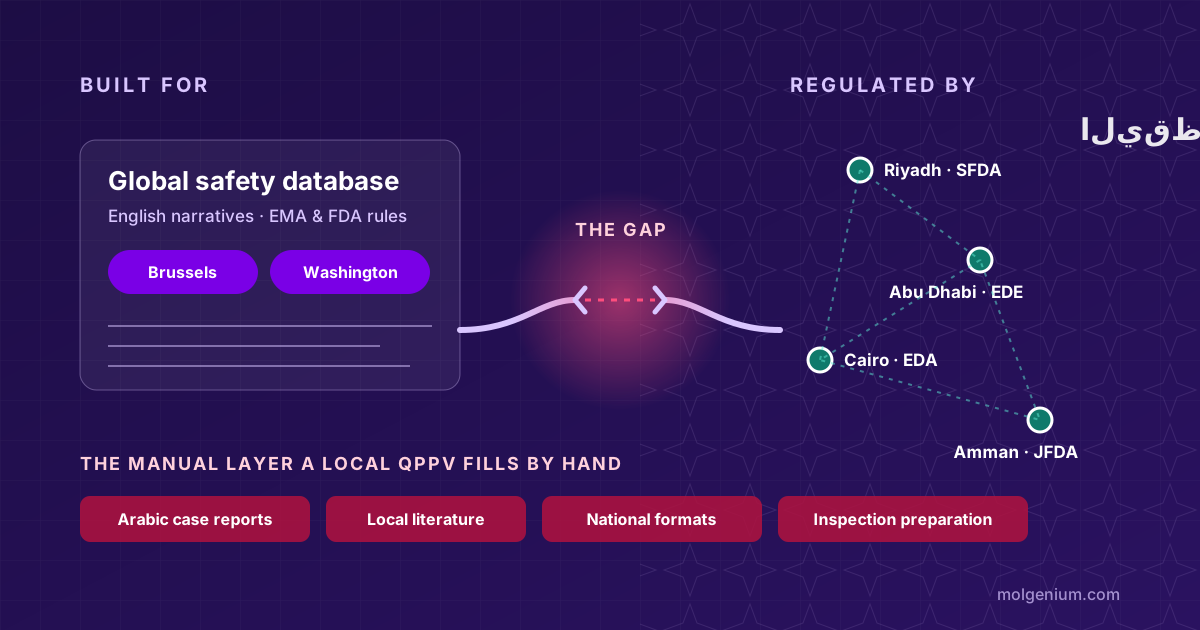
Most pharmacovigilance systems running in the Arab world were built for Brussels and Washington. The regulators in Riyadh, Abu Dhabi, Cairo and Amman have spent the last decade building their own rulebooks, and many companies are still trying to meet them with tools and processes designed for someone else's.
After more than 200 GMP audits and years of regulatory work for MENA markets, I see the same pattern repeat. A company has a validated global safety database, a solid SOP set copied from its European partner, and a QPPV who is quietly doing the regional work by hand: Arabic case reports, local literature, national submission formats, and inspection preparation that the global system was never designed to support.
That manual layer is what I call the Arab GVP gap. It is invisible on an org chart, but it shows up in inspection findings, late reports, and burned-out safety teams.
The rulebook is now local
The region no longer accepts "we follow EU GVP" as a complete answer. In 2014 the League of Arab States issued a GVP guideline for Arab countries built on the European modules, and national authorities have since written their own obligations on top of it. How far each has gone varies widely: a survey of national PV centres found large differences in implementation across Arab countries.
Saudi Arabia. The SFDA's GVP version 4.0, published in August 2025, requires a full-time local QPPV who resides in the Kingdom, a deputy, and registration through the Saudi Vigilance System (summary). Risk management plans now need a Saudi-specific annex. Since version 3.2, MAHs must also run an Arabic webpage listing how to reach the local QPPV. A dedicated ATMP GVP guidance was issued in April 2026 and takes effect in April 2027.
United Arab Emirates. Federal Decree-Law No. 38 of 2024 made the Emirates Drug Establishment the central federal authority for pharmacovigilance. MAHs must appoint UAE-based qualified persons and keep PV records for at least ten years after an authorisation expires (Chambers, 2026). In January 2026, 44 pharmaceutical services moved from MOHAP to the EDE (Freyr), so many companies are re-mapping who they report to and how.
Egypt. The Egyptian Drug Authority issued version 3 of its GVP guideline in 2026 (review). Local MAHs appoint a QPPV, and multinational MAHs need an Egypt-based Local Safety Responsible who acts as the single contact for the Egyptian Pharmaceutical Vigilance Center (EDA guideline, Tepsivo).
The rest of the Arab world. Jordan, Oman and other markets build directly on the Arab GVP framework. Oman's guideline, for example, requires a QPPV resident in Oman or another GCC state. In North Africa, many reports and documents arrive in French as well as Arabic, which adds a third language to the workload.
The direction is clear: more local people, more local documents, more local reporting channels, and more inspection scrutiny of all three.
Where the gap shows up
The gap rarely appears as one big failure. It appears as four small, recurring frictions that a QPPV absorbs every week.
Regional experts see the same structural issue. A 2026 Delphi consensus study on GCC pharmacovigilance priorities named limited integration of PV data systems as one of the region's specific needs.
Why imported systems struggle
Global safety databases are excellent at what they were built for: high-volume, English-language case processing under EMA and FDA rules. The Arab GVP gap sits in three places they were not designed to cover.
Language. Arabic is not an add-on field. Dialects, transliterated drug names and mixed-language narratives defeat generic translation and auto-coding. Every manual correction is a point where meaning, seriousness or a reporting clock can slip.
Data residency. Safety cases contain health data, which Saudi Arabia's Personal Data Protection Law treats as sensitive. Transfers abroad need a lawful mechanism, and a risk assessment is required when sensitive data moves outside the Kingdom on a continuous or large-scale basis (CMS). Other Arab countries apply their own data protection rules, so residency has to be answered country by country. A system hosted only in Europe or the US turns every case into a transfer question.
Local workflow. The local QPPV, the deputy, the national portal and the Saudi-specific annex are not steps in a global workflow. They live outside it, so the global audit trail ends exactly where the local inspector starts asking questions.
What a fit-for-region PV system needs
If you are a QPPV or safety head in the region, these are the questions I would ask any vendor, including us.
A system that cannot answer the first four does not close the gap. It only moves it to a different desk.
Measure your own gap first
Before you ask a vendor anything, it helps to know where your own system stands. I built a free benchmark for exactly that.
Closing the gap
This is the problem we designed VAIO-PV to address at Molgenium. AI assists from case intake through every pharmacovigilance workflow, and a qualified person makes the final decision every time. The AI does the heavy lifting; accountability stays with your safety team.
If the Arab GVP gap sounds familiar, send me a message. I am also happy to compare notes with QPPVs who simply want to discuss how they handle it today.
Sources
- League of Arab States, GVP for Arab Countries (version 3)
- National pharmacovigilance programs in Arab countries, survey (2020)
- SFDA, Guideline on Good Pharmacovigilance Practices, version 4.0 (August 2025)
- SFDA GVP version 3.2 changes, public consultation page
- Regulinked, summary of SFDA GVP 4.0 changes
- SFDA ATMP GVP guidance overview
- Chambers, Life Sciences 2026: UAE
- Freyr, transfer of 44 services to the EDE
- EDA, Guideline on Good Pharmacovigilance Practice in Egypt
- Review of EDA GVP version 3 (2026)
- Tepsivo, local pharmacovigilance in Egypt
- Oman MOH, Guideline on Good Pharmacovigilance Practices
- GCC pharmacovigilance research priorities, Delphi study (2026)
- CMS, Saudi PDPL one-year review